For iPhone

English

Neapolitan, 4 × 260 g, for dinner tomorrow at 7:00 PM?

Start mixing today at 6:18 PM

Fornata is an iPhone app that works out pizza dough and walks you through the mix. Pick one of eight pizzas, say when you eat and how many: you get the grams, the time of every step and a countdown on your lock screen.

Coming soon to the App Store

4.99 USD, paid once. No subscription, no account. The App Store shows the price in your currency. iPhone with iOS 17 or later.

The plan it builds for that answer

Today

  1. Mix the dough18 min
  2. The dough rests as one piece4 h
  3. Divide into 4 balls15 min
  4. The balls are proofing20 h

Tomorrow

  1. Turn the oven on40 min
  2. Bake8 min
  3. Dinner

The same plan to scale: 24 h 41 min from the first gram of flour to the table. The tomato-red bars are the hands-on work, 41 min in all. The rest of the time the dough works on its own.

Worked out for a stand mixer, an electric pizza oven at 470 °C and a 22 °C kitchen. On first launch the app asks how you mix and what you bake in.

How a batch goes

  1. Three questions

    “Which pizza are we making?”, “When are we eating?” and “How many pizzas?” Answer them on the Pizza tab and the plan appears right below.

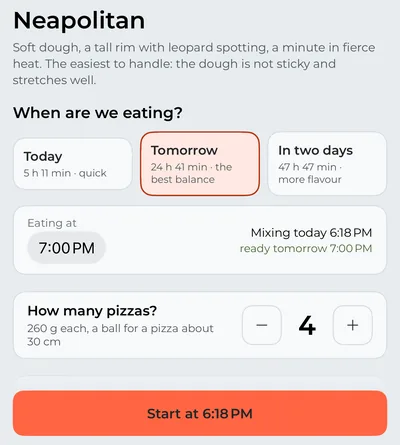
    The Pizza tab: the Neapolitan for dinner tomorrow, how many pizzas, and when to start mixing.
  2. Grams and times

    A shopping list in grams and every step with its time, written like a recipe: “Pour 397 g of water at 13 °C into the bowl.” Heating the oven is a step of its own, because it is the one people forget.

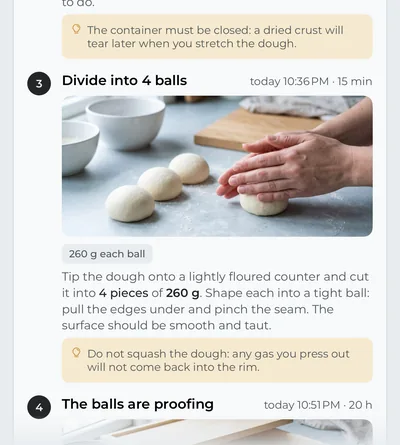
    The plan’s steps with their times and photos: dividing the dough into balls, with the weight of each ball, how to shape it and a tip.
  3. Start mixing

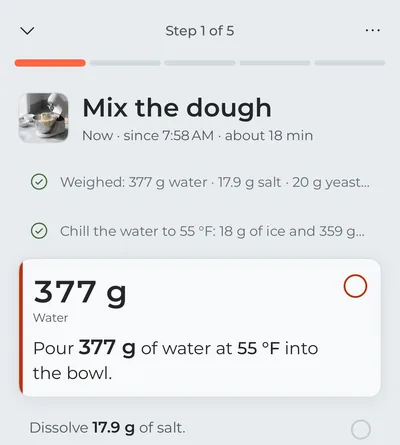
    Tap “Start at 6:18 PM” at the counter and cooking mode shows one step at a time: the current action with its grams in large type, the small tasks to tick off and a timer for the kneading. “Done, next” moves you on, and “Undo” saves you if you tapped too soon.

    Cooking mode on the first step, “Mix the dough”: weighing out and chilling the water are ticked off, and the water to pour now is in focus, its grams in large type.
  4. While it rests

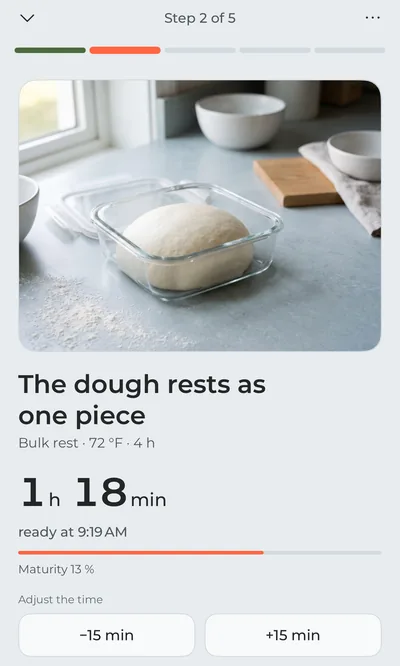
    A waiting step shows a photo of the dough at that stage, the countdown and, where it helps, “What ready looks like”. If the dough runs fast or slow, “−15 min” and “+15 min” shorten or lengthen the wait, and near the end “It’s ready, next” lets you move on early.

    Cooking mode while the dough rests: a photo of it in its container, the time left in large type and the “−15 min” and “+15 min” buttons.

The countdown stays on your lock screen

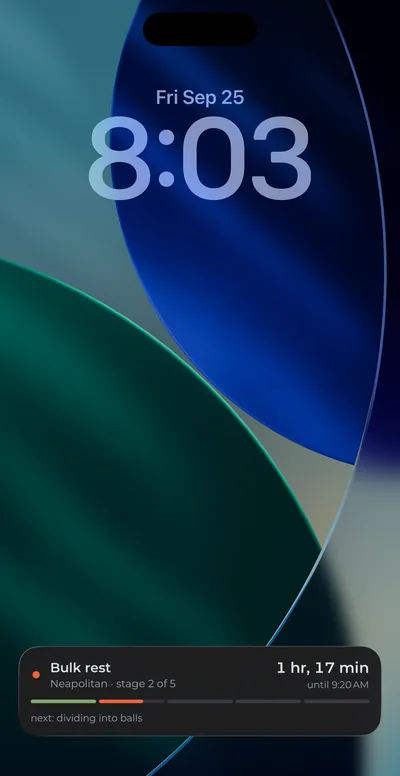
The current stage counts down on the lock screen and in the Dynamic Island, with the next one underneath. Reminders arrive even when the app is closed, and a tap on one, or on the countdown, opens the current step in cooking mode.

Kitchen warmer than planned? Tap the temperature on the Dough tab and the forecast follows. For the Neapolitan above, 24 °C instead of 22 °C in the bulk rest gives “Will be ready: tomorrow 6:17 PM, 42 minutes earlier than planned”.

The iPhone lock screen with a Fornata Live Activity at the bottom.
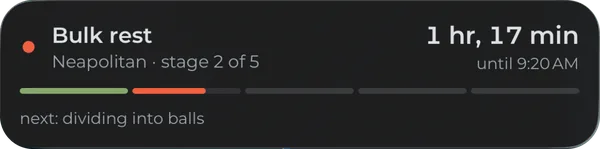
The Live Activity, enlarged: the stage in progress, the time left and the stage that comes next.

Eight pizzas, eight doughs

The grams are the app’s first answer for each style, before you change the number of pizzas.

Made for fierce heat

A pizza oven, electric, wood-fired or gas: 60–90 sec in the oven.

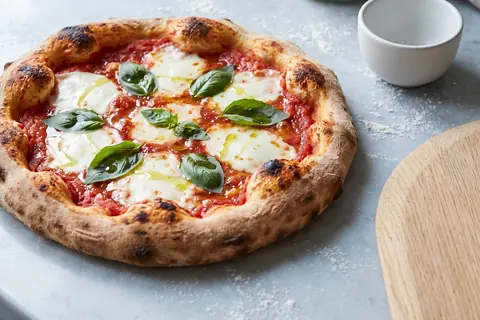
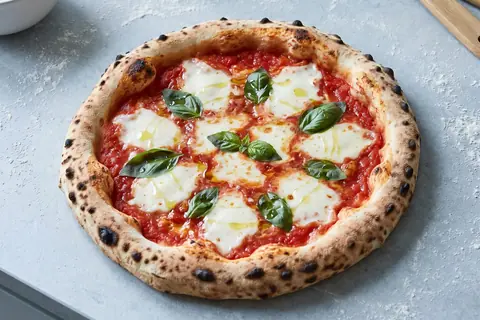
A Margherita seen from above: a puffy rim with dark leopard spots, tomato, melted mozzarella in patches and basil.

Neapolitan

Soft rim, a minute in the heat easy

Soft dough, a tall rim with leopard spotting, a minute in fierce heat. The easiest to handle: the dough is not sticky and stretches well.

Oven: 450–500 °C, 60–90 sec

  • 640g flour
  • 397g water
  • 17.9g salt
  • 0.57g yeastfresh

4 × 260 g, ready tomorrow
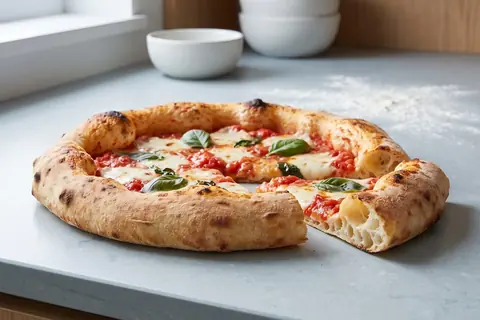
A pizza with a tall, puffy rim; one slice is pulled away to show the open, airy crumb.

Airy

Tall, open rim medium

The same Neapolitan, only wetter. The dough is softer and stickier, but the crumb comes out noticeably lighter. Needs confident hands and good flour.

Oven: 450–500 °C, 60–90 sec

  • 670g flour
  • 449g water
  • 17.4g salt
  • 0.62g yeastfresh

4 × 280 g, ready tomorrow

A pizza with a huge, inflated rim; a hand lifts a slice, and the rim is light and open inside.

Canotto

Inflated rim, little centre for the experienced

The showiest one. Made with a biga: a separate dough that matures 18 hours before mixing. Needs a very hot oven and patience.

Oven: 470–500 °C, 60 sec

Start the biga, 20 h 15 min

  • 325g flour
  • 146g water
  • 1.7g yeastfresh

Mix the dough

  • 325g flour
  • 321g water
  • 18.2g salt
  • 472g biga

4 × 280 g, ready in two days

A sourdough Margherita with a darker, blistered rim, and a jar of bubbly starter behind it.

Sourdough

Long maturing, gentle tang for the experienced

If you keep a starter. The flavour is deeper and more complex, and the dough stays fresh longer. It always takes a little longer than with yeast.

Oven: 450–500 °C, 60–90 sec

  • 629g flour
  • 409g water
  • 17.6g salt
  • 80.7g sourdough starterstiff, 50 % water, at the peak of its rise

4 × 260 g, ready tomorrow

The main difference is the temperature of the oven. A Neapolitan lives at 450–500 °C and bakes in a minute; anything that bakes longer than five minutes needs oil in the dough, otherwise it dries out. That is why New York and Roman thin have oil and the Neapolitan does not.

From the Book, chapter “Pizza styles”

Made for a home oven

An ordinary oven, on a stone or a steel, in a tray or a pan: 3–18 min in the oven.

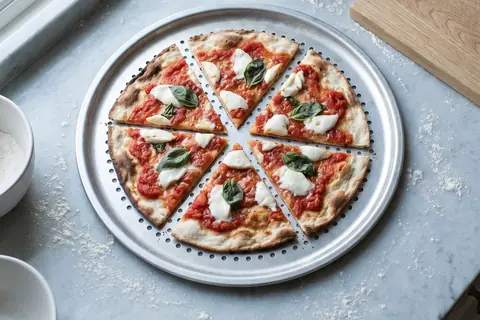
A very thin, flat pizza with no raised rim, cut into six slices on a round perforated tray.

Roman thin

Crisp, almost no rim easy

The exact opposite of the Neapolitan: thin, dry, brittle. There is almost no rim, the dough is rolled out with a pin, and this is the one case where a rolling pin is not a crime.

Oven: 300–330 °C, 3–5 min

  • 497g flour
  • 283g water
  • 10.9g salt
  • 1.2g yeastfresh
  • 19.9g olive oil

4 × 200 g, ready tomorrow

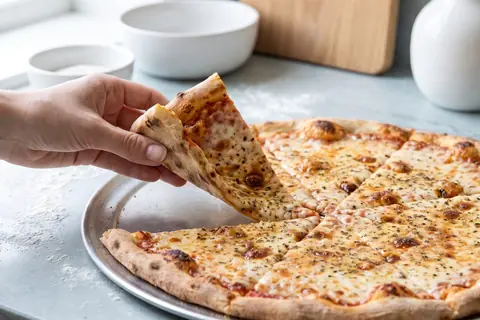
A large, thin pizza with melted cheese and oregano on a metal tray; a hand lifts a wide slice.

New York

Big, folds in half easy

A New York street classic: a slice the size of your face, folded lengthwise. Crisp base and soft top, with oil and a little sugar in the dough. Baked in an ordinary oven.

Oven: 290–310 °C, 6–8 min

  • 819g flour
  • 508g water
  • 16.4g salt
  • 4.6g yeastfresh
  • 20.5g olive oil
  • 12.3g sugar or malt

4 × 340 g, ready tomorrow

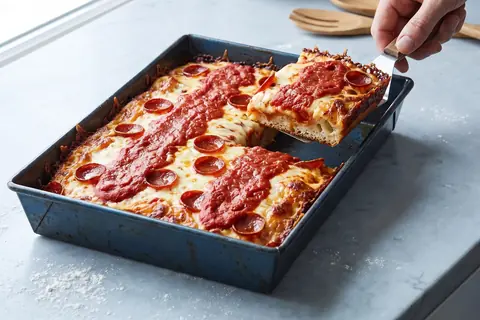
A rectangular pizza in a dark steel pan: caramelised cheese along the edges, stripes of tomato sauce, pepperoni, and one square lifted out on a spatula.

Detroit

Thick, crisp cheese edge medium

Fluffy and soft inside, with caramelised cheese fried onto the walls of the pan along the edges. Baked in a steel pan in the oven, and you hardly stretch it by hand.

Oven: 280 °C, 12–15 min

  • 1036g flour
  • 746g water
  • 20.7g salt
  • 3.2g yeastfresh
  • 20.7g olive oil

4 × 450 g, ready tomorrow

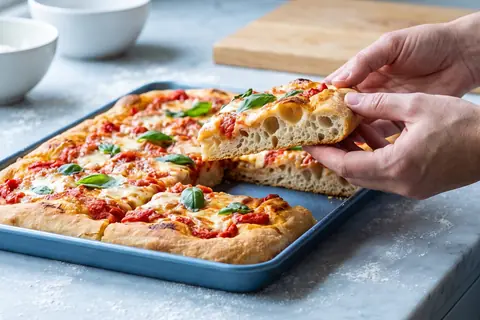
A Roman pizza in a blue tray, cut into rectangles; two hands lift one piece to show the tall, open crumb.

Roman in a tray

Open crumb, cut in squares medium

Baked in an ordinary oven in a tray. The dough is very wet, but you hardly knead it, only fold.

Oven: 280 °C, 15–18 min

  • 1320g flour
  • 1056g water
  • 29g salt
  • 4.2g yeastfresh
  • 26.4g olive oil

4 × 600 g, ready tomorrow

Only have a home oven? The app moves the Neapolitan there too: on a stone at 280 °C it plans 6 min a pizza instead of 65 sec, and heats the stone for 50 min first.

Why the longer dough takes more yeast

Yeast keeps time by warmth, not by the clock. Fornata turns every stage into hours at 20 °C and doses the yeast from a model calibrated against practice. An hour in the fridge at 4 °C counts as only 9 min, so the dough that spends most of its time in the cold gets more yeast.

Tomorrow

24 h 41 min on the clock, all of it at 22–23 °C

30.0 h at 20 °C

0.57 gfresh (compressed)

In two days

47 h 47 min on the clock, 38 h of it in the fridge at 4 °C

17.0 h at 20 °C

1.2 gfresh (compressed)

  • on the counter
  • in the fridge
  • the same plan in hours at 20 °C
How the 0.57 g is worked out
StageSpeedHours at 20 °C
Mixing18 min at 23 °C× 1.350.405
Bulk rest4 h at 22 °C× 1.224.88
Dividing into balls15 min at 22 °C× 1.220.305
Ball proofing20 h at 22 °C× 1.2224.4
24 h 41 min on the clock29.99

Fresh yeast = 9.28 ÷ 29.991.368 = 0.089 % of the flour, and 0.089 % of 640 g is 0.57 g.

The curve is calibrated on doughs that work in practice: 24 h at 20 °C take 0.12 % fresh yeast, 48 h take 0.05 %.

Freshly shaped dough balls, small and smooth, set well apart on flour in a wooden box.

Today,

Just shaped

The same box later: the balls have roughly doubled, spread a little and almost touch.

Tomorrow,

Ready for the oven

The step in between, as the app puts it: “Lay the balls out in a box or lidded container with space between them and leave at 22 °C for 20 h. A ball is ready when it has roughly doubled, spread slightly on the bottom and springs back slowly.” The yeast is dosed so that the balls are ready just as the oven is hot.

The water follows the mixer

Mixing warms the dough, a machine more than hands, so the water starts cooler. The same Neapolitans in a 22 °C kitchen:

  • By hand21 °C
  • Fork mixer (forcella)16 °C
  • Stand mixer13 °C
  • Bread machine, dough setting10 °C
  • Spiral mixer4 °C

In summer, when the tap runs warm, the step tells you how much ice to add.

The oven gets its own step

When to switch on, how hot and how long a pizza takes follow what you bake in. The same dinner at 7:00 PM:

  • Electric pizza oven470 °C, 65 sec per pizza
  • Wood-fired oven470 °C, 65 sec per pizza
  • Outdoor gas oven450 °C, 70 sec per pizza
  • Oven with a steel290 °C, 5 min per pizza
  • Oven with a stone280 °C, 6 min per pizza
  • Pan and grill250 °C, 6 min per pizza

In a home oven with a stone the whole batch takes 30 min to bake, so the plan moves: mixing starts at 6:27 PM instead of 6:18 PM.

A pizzaiolo’s handbook inside the app

The Book tab explains why dough behaves the way it does, with tables to cook from and a list of faults with their fixes. Offline, like the rest of the app.

  1. How to useThree screens and one order of things
  2. Pizza stylesHow they differ and which to choose
  3. The canonWhat counts as a Neapolitan pizza in the first place
  4. FlourW, protein and why ordinary flour will not hold a day
  5. WaterHydration and temperature, two different levers
  6. SaltTaste, structure and a brake on the yeast
  7. YeastHow much, which kind and how to convert
  8. FermentationTemperature matters more than hours
  9. MixingOrder, stages and temperature
  10. Bulk rest, dividing, proofingThe three stages that decide the rim
  11. BakingWhat to do when your oven cannot reach 480 °C
  12. When it goes wrongWhat exactly went wrong and what to change
  13. KitThe minimum that really changes the result
  14. GlossaryThe Italian terms you meet in recipes
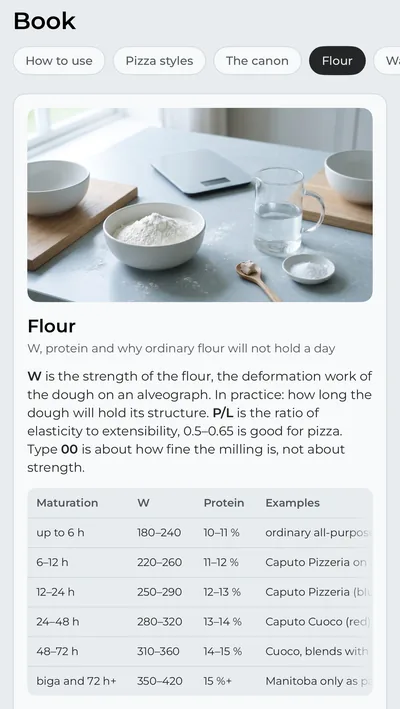
The Book tab, chapter “Flour”: a table of maturation time against W strength and protein.
The chapter “Flour”: how strong a flour each maturation time needs.

When it goes wrong

Three lines from its table of faults:

  • The dough tears when stretchedCause: weak flour or not matured; cold doughFix: stronger flour, +2–4 h of ball proofing, warm it to 18–20 °C
  • The ball spread into a pancakeCause: over-proofed or too warmFix: less yeast or a cooler ball proofing
  • White base, burnt topCause: cold floor, the grill is too closeFix: heat the stone longer, use a lower rack

Before you buy

Price
4.99 USD, paid once. No subscription, no in-app purchases, no account. The App Store shows the price in your currency.
Privacy
Fornata collects nothing about you. No ads, no tracking. Your batches stay on your iPhone and, through “Sync with iCloud” under More, in your own iCloud. Switch it off and the iCloud copy is deleted. All the app sends us is one anonymous note that it has been installed. Privacy policy
Offline
Everything works without a connection.
History
Every batch with your rating and a note for next time. “Repeat” brings the same recipe back for a new dinner.
Kitchen
Degrees in °C or °F, whichever your iPhone uses, and the yeast you have: “Fresh (compressed)”, “Instant dry” or “Active dry”, with the grams worked out for it. You can change both under More.
Detailed mode
In the shopping list every ingredient is shown as a percentage of the flour, and the flour gets the strength W it needs instead of a brand. The calculation itself does not change. Switch it on under More.
Languages
14. The app follows the language of your phone, and its light or dark look.
Requires
iPhone with iOS 17 or later.